React Native Job-Ready Roadmap 2026
The complete 14-week interactive roadmap to land high-paying remote React Native roles in 2026. Focuses on the New Architecture, Expo Router v7, and performance optimization.

30-Second Key Takeaways
TL;DRQuick digest before you dive deep
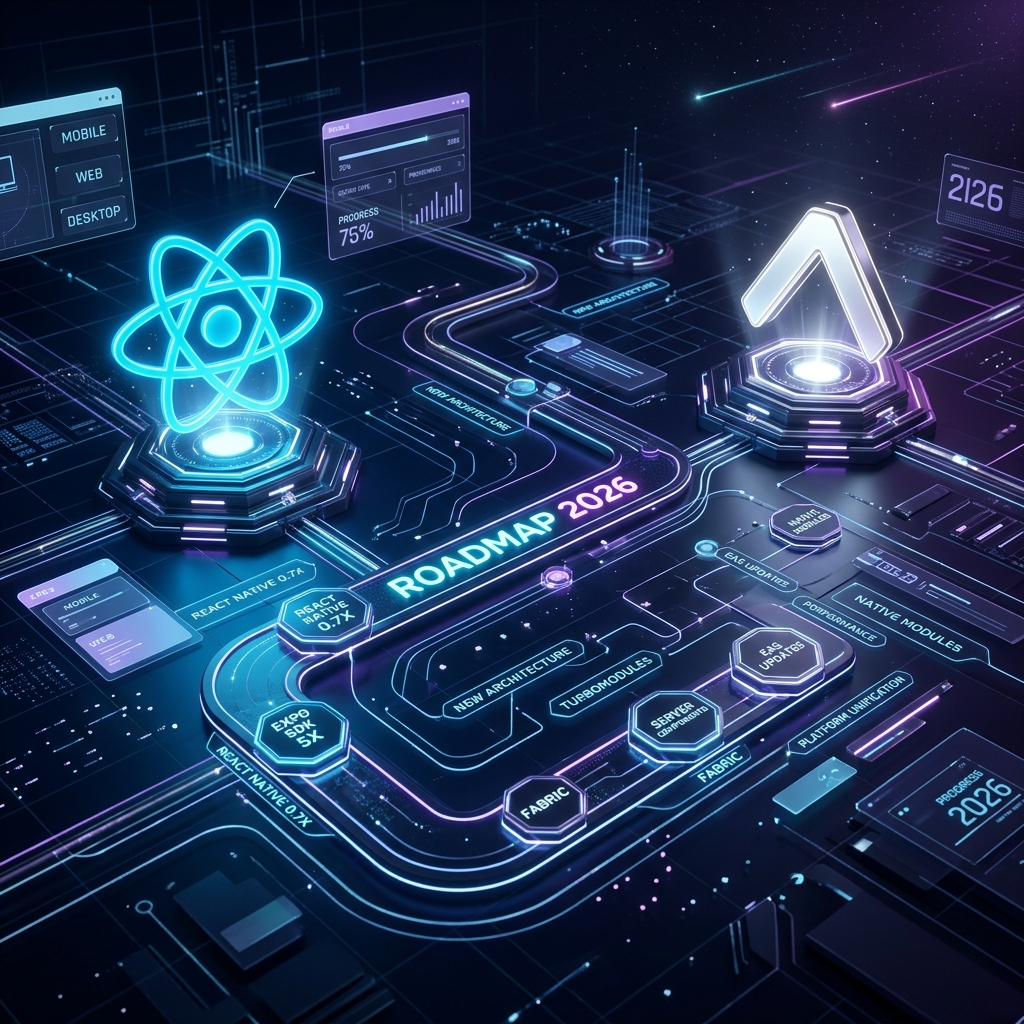
The Bridgeless Era is Here. Are you ready?
14-Week Track
A structured, battle-tested timeline covering foundational setup to production-grade native pipelines.
Bridgeless JSI
Built specifically for standard React Native 0.76+ architecture with synchronous C++ native interface access.
Remote Careers
Curated around hiring data from top US/European remote teams seeking deep native-first engineering skills.
Building cross-platform mobile apps has undergone a massive paradigm shift. The classic asynchronous "bridge" that powered React Native for a decade is officially End of Life (EOL) as of March 2026. It has been replaced entirely by direct, synchronous native access via the JavaScript Interface (JSI).
For developers aiming to land remote roles, the bar has risen. Recruiters are no longer looking for "web developers who write a bit of CSS for mobile." They require deep mobile-first optimization, custom TypeScript compilation configurations, React Navigation v7 routing, and native Xcode/Gradle build tool experience.
This roadmap maps out the exact track to become production-ready. Use the interactive career dashboard below to audit your skills, check off milestones, and grab study worksheets as you progress.
Interactive Career Dashboard
Track your progress and copy prompt worksheets locally
Overall Completion Status
Ready to start your remote career journey? Check your first skill above! 🎯
Foundation - React Native + TypeScript core
Weeks 1–2Every job listing requires this
View, Text, Image, TextInput, ScrollView, SafeAreaView, KeyboardAvoidingView, Platform
Mobile-first layout, responsive sizing with Dimensions, platform-specific styles
Typed props, typed state, typed navigation params - non-negotiable for 2026 roles
Virtualized lists, keyExtractor, renderItem, ListEmptyComponent, pagination
Navigation - React Navigation v7
Weeks 3–4Asked in every interview
State management - Redux Toolkit + RTK Query
Weeks 5–6Your current focus - keep going
Forms + storage + auth
Weeks 7–8Core of every real app
Performance + animations
Weeks 9–10What separates mid from senior
New architecture + Expo production
Weeks 11–122026 table stakes - old arch is EOL
Testing + tooling + soft skills
Weeks 13–14The final layer that closes offers
01.Foundation - React Native & TypeScript Core
In the early weeks, your main objective is mastering mobile-first rendering mechanics. On mobile, layouts do not work like web browsers. There is no grid system, document-based text flow, or inherited styling sheet. Everything in React Native revolves around a restricted subset of Flexbox implemented on top of Facebook's Yoga engine.
Key Technical Shifts
- Viewport Constraints: Always style components responsively using relative units or the
useWindowDimensions()hook. Hardcoded sizing is the number-one reason apps fail QA on small screens (e.g., iPhone SE) or tablets. - Keyboard Layouts: Input screens must use
KeyboardAvoidingViewwith platform-specific offsets (usingPlatform.select()) to prevent the virtual keyboard from covering inputs. - FlashList Over FlatList: Shopify's
@shopify/flashlisthas replaced standardFlatListfor large scroll lists. It recycles layout views rather than garbage-collecting them, achieving consistent 60 FPS scrolling on lower-end Android devices.
Recruiter Talking Point
"In interviews, don't just say you know how to display lists. Explain cell recycling. Point out how FlashList reuses cell components under the hood, eliminating constant JS garbage collection spikes, which is a major source of frame drops on Android."
03.Data Fetching & State - RTK Query & Zustand
For global UI state (like themes, user sessions, active filters), startups prefer lightweight stores like Zustand. However, for remote enterprise work, Redux Toolkit (RTK) paired with RTK Query remains the dominant stack.
Caching & Optimistic Updates
Mobile network conditions are volatile. The app must feel instant, regardless of latency. RTK Query excels here through its automatic cache tags and optimistic updates support-allowing the UI to instantly reflect a toggled transaction status before the server responds:
import { createApi, fetchBaseQuery } from '@reduxjs/toolkit/query/react';
export const transactionApi = createApi({
reducerPath: 'transactionApi',
baseQuery: fetchBaseQuery({ baseUrl: '/api/' }),
tagTypes: ['Transaction'],
endpoints: (builder) => ({
toggleTransaction: builder.mutation<void, { id: string; completed: boolean }>({
query: ({ id }) => ({ url: `transactions/${id}`, method: 'POST' }),
async onQueryStarted({ id, completed }, { dispatch, queryFulfilled }) {
// Optimistic update
const patchResult = dispatch(
transactionApi.util.updateQueryData('getTransactions', undefined, (draft) => {
const item = draft.find(t => t.id === id);
if (item) item.completed = completed;
})
);
try {
await queryFulfilled;
} catch {
patchResult.undo(); // Rollback on failure
}
},
}),
}),
});04.Forms, Native Storage & JWT Auth
Handling user input and sensitive authentication credentials requires specialized storage mechanisms. Standard web localStorage does not exist on mobile. Instead, unencrypted key-value pairs are stored via AsyncStorage, while private tokens/keys require hardware-encrypted systems like iOS Keychain and Android Keystore (wrapped by Expo's SecureStore).
JWT Interception Flow
A robust JWT structure involves holding a short-lived access token in memory and a secure refresh token in SecureStore. When an access token expires, Axios interceptors or RTK Query base queries must catch the 401 response, request a new token, update the state, and seamlessly replay the failed request.
Validation with Hook Form & Zod
Using controlled components with simple React state creates slow typing responses on low-spec Android devices due to constant re-renders across the bridge. The solution is React Hook Form, which handles input state un-controlled, validating against a Zod schema only when triggered.
05.Performance Tuning & Reanimated 3
UI fluidness is the divider between mid-level and senior engineers. If gestures and animations are handled on the main JavaScript thread, any heavy network fetch or database write will block the thread, leading to visual freezing (jank).
Reanimated Worklets
React Native Reanimated 3 solves this by using "worklets"-small JavaScript functions that are serialized and compiled to run directly on the native UI thread. Since they run independently, your animations will remain at 60/120 FPS even if the JS thread is fully blocked.
List Performance Tuning
For lists, always set getItemLayout when cell heights are constant. This prevents the list from dynamically recalculating heights during scroll, saving valuable CPU cycles.
06.The New Architecture (JSI) & EAS Pipelines
The March 2026 Shift
Historically, JavaScript and Native (C++/Java/Objective-C) layers communicated via asynchronous JSON messaging over "the Bridge". In modern React Native (default since 0.76, old bridge EOL March 2026), the JavaScript Interface (JSI) allows JS code to hold direct C++ references to native objects. The communication is now synchronous, eliminating serialization bottlenecks entirely.
EAS (Expo Application Services)
Understanding EAS is critical for modern delivery. You should know how to configure eas.json to compile your app on Expo's cloud servers, manage Apple/Android provisioning profiles, and dispatch Over-The-Air (OTA) bug fixes using EAS Update.
07.Testing & Native Build Systems
The final week focuses on robust testing and native troubleshooting. The biggest bottleneck in remote work is dependency mismatching when native compilation fails in Gradle or Xcode.
Troubleshooting Native Logs
- Android builds: Open the
android/directory in Android Studio. Inspect Gradle console outputs and fix dependency duplicate class errors. - iOS builds: Open the
ios/directory inside Xcode. Inspect compilation errors in the build log tab, manage Podfiles, and handle cocoapods cache invalidation. - Component Testing: Write unit and integration tests using Jest and
@testing-library/react-nativeto mock native dependencies (like safe-area contexts or AsyncStorage) using Jest mock APIs.
Frequently Asked Questions
Can I learn React Native without knowing React?
It is not recommended. React Native relies on React paradigms such as rendering schedules, states, memoization, and hooks. Spend at least 2 weeks understanding React web basics before transitioning to mobile.
Is the old bridge completely dead?
Yes, for modern projects. React Native 0.76 turned on the New Architecture by default, and legacy bridge support is deprecated and phased out completely as of March 2026. All new projects should target the JSI-based architecture.
Should I learn Swift or Java alongside React Native?
You don't need to write them fluently initially, but you must be able to read Gradle/Xcode configurations, manage build configurations, and implement small bridging scripts (TurboModules or Config Plugins) to access native APIs.
Enjoyed this article?Leave a reaction
Tap multiple times to show love!
Build a Consistent Coding Habit
Stop guessing and start building. This e-book provides practical strategies, exercises, and routines to help you code regularly and improve steadily.
Get E-BookMaster Unfamiliar Codebases
Struggling to make sense of someone else's code? Learn practical strategies to navigate, analyze, and master unfamiliar codebases with confidence.
Get E-Book
💬 Discussion